Salt Lake City Public Art Program

Connecting people to place and place to stories since 1984

  • Home
  • Public Art Projects
    • Public Art Collection
    • Community Reinvestment Agency
    • Art in Transit
    • Airport
    • City & County Building
  • About
    • About the Program
    • Salt Lake Art Design Board
    • Works In Progress
  • For Artists
    • Join Us
    • Calls for Artists
    • Workshops
    • Artist Resources
    • Artist Selection Process
    • More Opportunities
  • For Community
    • Pre-Qualified Artist Pool
    • Gifts or Donations

Ballpark Neighborhood Mural: The Seabirds Greeted the Moon

November 3, 2025 by Renato Olmedo-Gonzalez

Over the summer of 2025, the Ballpark neighborhood was transformed into a vibrant open-air gallery through the creation of ten new murals. Each mural emerged from a unique collaboration between a local business and a local artist selected from the Public Art Program’s Pre-Qualified Artist Pool. Business owners offered their walls as creative canvases, while artists designed site-specific works that captured the people, stories, and distinctive character of the neighborhood.

Funded by the Salt Lake City Community Reinvestment Agency (CRA) and programmed by the Salt Lake City Arts Council, the initiative infused the neighborhood with new energy, color, and creativity. The project celebrated and strengthened the artistic spirit already thriving in the community, uplifting small businesses, showcasing local talent, and cultivating a deeper sense of place. Together, these ten murals formed a cohesive and dynamic collection that reflects what makes the Ballpark neighborhood truly one of a kind.

Caro Nilsson, born in 1993 in Vancouver, Washington, creates paintings rooted in impressionism and a deep relationship with the land. Her work explores the connection between contrasting forces—grief and hope, shadow and light—framed through the landscapes where these emotional and natural dynamics unfold. In public art, she centers ecology and belonging, reminding viewers that our built environments are part of larger ecosystems and that we are connected to both place and one another. Caro holds a B.A. in Fine Art with a Distinguished Major in Printmaking and a B.S. in Architecture from the University of Virginia, and she has completed more than 50 murals. Now based in Salt Lake City, she continues to focus on community building and environmental stewardship, including her 2025 exhibition For Those Who Bear Witness at the Northeastern Nevada Museum, which examined air quality in the Mountain West.

Photos by Logan Sorenson
Ballpark Neighborhood Murals: Speed Sweep

November 3, 2025 by Renato Olmedo-Gonzalez

Over the summer of 2025, the Ballpark neighborhood was transformed into a vibrant open-air gallery through the creation of ten new murals. Each mural emerged from a unique collaboration between a local business and a local artist selected from the Public Art Program’s Pre-Qualified Artist Pool. Business owners offered their walls as creative canvases, while artists designed site-specific works that captured the people, stories, and distinctive character of the neighborhood.

Funded by the Salt Lake City Community Reinvestment Agency (CRA) and programmed by the Salt Lake City Arts Council, the initiative infused the neighborhood with new energy, color, and creativity. The project celebrated and strengthened the artistic spirit already thriving in the community, uplifting small businesses, showcasing local talent, and cultivating a deeper sense of place. Together, these ten murals formed a cohesive and dynamic collection that reflects what makes the Ballpark neighborhood truly one of a kind.

Born and raised in Salt Lake City, Utah. Trent Call graduated from the University of Utah in 2004 with a BFA. He is actively involved in a diversity of ongoing projects. Trent’s work combines formal academic painting, comics, graffiti, and outmoded Americana. He currently works out of CAPTAIN CAPTAIN Studios in beautiful downtown Salt Lake City.

Photos by Logan Sorenson

Ballpark Neighborhood Murals: Safe, Home, Homerun

November 3, 2025 by Renato Olmedo-Gonzalez

Over the summer of 2025, the Ballpark neighborhood was transformed into a vibrant open-air gallery through the creation of ten new murals. Each mural emerged from a unique collaboration between a local business and a local artist selected from the Public Art Program’s Pre-Qualified Artist Pool. Business owners offered their walls as creative canvases, while artists designed site-specific works that captured the people, stories, and distinctive character of the neighborhood.

Funded by the Salt Lake City Community Reinvestment Agency (CRA) and programmed by the Salt Lake City Arts Council, the initiative infused the neighborhood with new energy, color, and creativity. The project celebrated and strengthened the artistic spirit already thriving in the community, uplifting small businesses, showcasing local talent, and cultivating a deeper sense of place. Together, these ten murals formed a cohesive and dynamic collection that reflects what makes the Ballpark neighborhood truly one of a kind.

Paul Heath is a life-long Salt Lake City resident who graduated from the U. of U. with a BFA in Drawing and Painting in 1985. He has been involved in several public art projects, from the history of Salt Lake City baseball for the etched glass windows at Smith’s Ballfield, to this mural to celebrate the Ballpark Community. Since 2013, Paul has also been an elementary Visual Art teacher with the Beverley Taylor Sorenson Arts Learning Program in the Salt Lake City School District. He received a master’s degree in education with USU in 2018. Here is how Paul describes his work for public and private commissions: “I characterize my work as “Pop-Nostalgia”. As a lifetime Salt Lake City resident, I draw inspiration from the awesome neon signs we have around us. I see my work as playful documentation, looking at objects and neighborhood niches through a lighter lens. I also paint images of older antique toys… to elicit a smile or friendly smirk.”

Photos by Logan Sorenson

Ballpark Neighborhood Murals: For the Wild Ones

November 3, 2025 by Renato Olmedo-Gonzalez

Over the summer of 2025, the Ballpark neighborhood was transformed into a vibrant open-air gallery through the creation of ten new murals. Each mural emerged from a unique collaboration between a local business and a local artist selected from the Public Art Program’s Pre-Qualified Artist Pool. Business owners offered their walls as creative canvases, while artists designed site-specific works that captured the people, stories, and distinctive character of the neighborhood.

Funded by the Salt Lake City Community Reinvestment Agency (CRA) and programmed by the Salt Lake City Arts Council, the initiative infused the neighborhood with new energy, color, and creativity. The project celebrated and strengthened the artistic spirit already thriving in the community, uplifting small businesses, showcasing local talent, and cultivating a deeper sense of place. Together, these ten murals formed a cohesive and dynamic collection that reflects what makes the Ballpark neighborhood truly one of a kind.

Lindsay Huss is a graduate of Weber State University with a degree in Visual Arts. After a decade-long teaching career, she transitioned to art full-time. Her work, a captivating blend of realism and abstraction, delves into themes of self, community, and placemaking. Recognized with numerous accolades, including the Indie Ogden Award for Best Ogden Artist and the Ogden Mayor’s Award for Visual Arts, Huss remains an active figure in the Ogden art scene, contributing to several murals in the Nine Rails Creative District and throughout Utah.

Photos by Logan Sorenson

Seven Canyons Refuge

October 13, 2025 by Renato Olmedo-Gonzalez Leave a Comment

The reimagined Seven Canyons Fountain incorporates new sculptural and design elements that invite visitors to engage with Salt Lake City’s landscapes, histories, and ecosystems in renewed and meaningful ways. Highlights include “People Perches”—cast bronze sculptures that encourage visitors, to explore birdsong through sound, touch, braille, and sonogram forms—and cast bronze site repairs inspired by kintsugi, the Japanese art of golden mending, symbolizing resilience and renewal. Shishi-odoshi water features at each canyon headwater engage visitors in hands-on water stewardship, while a representation of Salt Lake City’s historic streetcar lines, powered by Big Cottonwood Creek, connects the city’s transportation history to its hydrological systems. Additional elements include etched granite tile cairns —designed by Rios Pacheco of the Northwest Band of the Shoshone Nation and artists with the Noun Project—and a redesigned Great Salt Lake feature, reimagined as a spiral to encourage play and education.

Woven together, these elements reflect five core themes: our relationships with sister species (especially birds); the interconnected water systems of the Bonneville Basin; the legacies of the region’s First Peoples; stewardship and healing of meaningful places; and expanded access to multi-sensory experiences. Artist Stephen Goldsmith collaborated with experts in ornithology, accessibility, and sound design—including Alma Schrage, Milad Mozari, the Cornell Lab of Ornithology, and Tracy Aviary—to create an immersive and inclusive public experience. Embedded QR codes link visitors to curated audio content, extending the artwork’s reach beyond the site itself.

Photo Credit: Logan Sorenson

________________________________________________________________

Seven Canyons Refuge: A Prelude
Artist Statement by Stephen Goldsmith

Origins of the Refuge
In 1991 Dr. Obert C. Tanner invited architect Boyd Blackner and me to design a place where people could share his love of water and celebrate its life-giving force in the valley. Together with Boyd’s daughter, architect Elizabeth Blackner, we asked questions about place, people, and water – the group of us asking questions shaped the form of the Seven Canyons Fountain when it opened in 1993.

From Fountain to Refuge
The reemergence of the space comes at a time when the community is facing urgent challenges about water in the valley, especially the future of the Great Salt Lake. Our relationships with water, and the complex ways it connects us to other species and to each other, are now central questions. There is broad community recognition that this place holds value, should not be discarded, and can be repaired. As a metaphor, it invites us to ask: what kinds of repairs might we make in other places, with people, communities, or even ourselves?

We hope that our reimagining of Dr. Tanner’s gift might inspire new, creative responses to these challenges. The child who brings Legos to the refuge to build imaginary neighborhoods, the child who climbs the boulders with or without the fear of falling, the child who sails up the hill on wheels…these people may one day become designers of the city itself.

The Land Changes
In light of these challenges, the new collaborative team has preserved the fountain’s infrastructure in hopes that one day this space—once a refuge from summer heat—might provide cool respite again. The boulders throughout the refuge come from the seven canyons of the rivers that feed the Great Salt Lake and were part of the original Seven Canyons Fountain. The original sculpted landforms remain, with the runnels that once carried water to the Jordan River and on to the Great Salt Lake. Throughout the refuge you may spot features that draw inspiration from the Japanese art and philosophy of repair known as kintsugi. In this spirit, we hope you find the place repaired and renewed from Seven Canyons Fountain to Seven Canyons Refuge.

Stories of Place
The new elements of the refuge are designed to open windows into our relationships with the interconnected ecologies of life in the valley. The Greek roots of the word “ecology” are oikos and –logia…in addition to meaning environment, the root oikos also refers to family and the family’s house, dwelling place. In American Sign Language, the sign for ecology translates to English as the study of ecosystems, but the combined root signs for ecosystem in the language more literally translate to the connected world.

How are we connected? Who lived in the valley before it became Salt Lake City? What did they call the seven canyons on the valley’s east side? How did they serve as stewards of this land— land still sacred to the descendants of the First Peoples who continue to live here? How have our relationships with beaver, birds, buffalo, plants, and fish shifted over time? Why does Salt Lake City have a sister city in Japan named Matsumoto?

Stories in Stone
Forty granite tiles, and three etched into boulders, placed as cairns throughout the refuge, carry some of these narratives. You will find two designed by the artist Rios Pacheco of the Northwestern Band of the Shoshone Nation, while several others were designed by artists with the Noun Project, an international initiative to build a global visual language. Among the stories shared are those of Warm Springs, Hot Springs Lake, and the Stairs Plant in Big Cottonwood Canyon. The Stairs Plant once harnessed the power of Big Cottonwood Creek to generate electricity for 146 miles of trolley track in Salt Lake City.

Paths of Water
Though the creeks of the refuge’s seven canyons are dry, at the headwaters of each, an element from Japanese culture called shishi odoshi has been installed. These shishi odoshi are built to receive water and when enough water has been added, the weight of the water given will cause them to tilt and release water into the creek runnel. On cooler days, with enough water, it may reach all the way to the lake.

How much water will it take? How long will it take? Where will it come from? Why is there an organization in Salt Lake City named The Seven Canyons Trust?

While the act of feeding the rivers through the shishi odoshi will not restore our lake and rivers to what they were, can this small, hands-on act of feeding the rivers help ground us in a more reciprocal relationship with the water? Can it deepen our understanding of water and stewardship?

What if children playing here reimagine how the power of Big Cottonwood Creek, power that once fueled the city’s mobility, could inspire them to solve our mobility-related air quality problems? Such questions could spark ideas about public health, safety, affordability, the joys of water, and shared spaces.

The Spiral
At the Great Salt Lake end of the refuge, a spiral form invites direct engagement. Why a spiral? If not a nod to Robert Smithson’s Spiral Jetty , perhaps it reflects the spiral’s deep cultural resonance—as a symbol of growth, journeys, and the cycles of life?

Birdsong and Empathy

Liberty Park, home to more than 180 bird species, also connects seamlessly with nearby Tracy Aviary. If you listen at the right times of day and year you will hear birdsong. But what if someone is deaf? Or if someone is blind? How might their experience of birdsong differ, and expand, through other senses?

To explore this, the refuge includes “People Perches,” designed around 18 bird species and their songs. Each perch includes a three-dimensional representation of notes from a bird’s song. Visitors can run their fingers across the sculpted forms, experiencing the variation among sonograms by touch. Additionally, a QR code connects visitors to the Macaulay Library, an online archive of animal sounds where they can both hear the bird’s song and see its sonogram. Both deaf and hearing ornithologists use these sonograms to study bird song and behavior, and as hearing ornithologist Donald Kroodsma has highlighted through a lifetime of research and writing, “seeing” birdsong can deepen our appreciation of its intricacy and beauty.

Importantly, an ornithologist at Tracy Aviary helped select only birdsongs that wouldn’t be threatening to birds that live and nest in Liberty Park. If nesting birds felt threatened hearing birdsongs of their species streaming online, they could be threatened, and displaced. What beauty and intricacies emerge when you perceive birdsong through different senses? As you explore the different birdsongs presented at each perch, do you find different songs beautiful to the touch? To see? To hear?

Earth as Refuge
The People Perches also invite us to feel our place in the larger home of Earth. Sitting at a perch, holding its handgrips, and looking skyward, one might consider this truth: We are hurtling through time and space at 67,100 miles per hour, together. One can sit and hold on to the Earth as tightly as we can.

A Gift to the City
It is hoped that all who visit the Seven Canyons Refuge can find refuge in whatever way they most need —be through birdsong or water, through story or memory, through action or reflection, or simply in the view of the Wasatch Mountains’ seven canyons. This collaborative reimagining of the space continues as a gift to the city.

Acknowledgments
The Seven Canyons Refuge was made possible through the vision, hands, skills, and persistence of many people. We gratefully acknowledge:

Design Collaborations
Liz Blackner, Eric Powell, Milad Mozari, Kody Baird, Rios Pacheco, Patty Timbimboo, Angelica Pavoni, Stephanie McCarthy, Ian Chambers, Bob Herman, Greg Brooks, Glen Beckstead, Jim Zaugg.

Community, Environmental, and Cultural Guides
Felicia Baca, Renato Olmedo-González, Tim Brown, Bryan Olsen, Donald Kroodsma, Alli Smith, Drew Weber, Jeff Niermeyer, Gavin Noyes, Sylvia Nibley, Maria Moncur, , Bradley Parry, Malcolm Lehi, Jacob Crane, James Toledo, Katherine Andra, Amy Childress, Marie Parker.

Fabrication and Construction
Darian Westrick, Freddy Martinez, Kevin Maag, Brian Ivie, Enrique Valle, Jared Neves, Brett Wright, Bret Garner, Jackson Wamboldt, Sarah Bishop, Joseph Ramos, Cal and Jordan Wadsworth, Machelle Booty, Johnny Roe, Michael Roe and the Black Line Concrete crew, Lance Larkin, Mario Torres, Jeffrey Clarson, Tony Goiburn, Kayden Sandoval, Dean Scott, Kevin Scott, Kyle Wrobleski, Nathan Johnsen, Gary Petit, Victor Ramos, Paul Davies, Dustin D. Barton.

Special thanks to Alma Schrage, wildlife ecologist and artist. Her wisdom and skill at connecting ideas and illuminating essences has been invaluable throughout this adventure. And to Sam Goldsmith, whose unwavering belief that the original space held value, kept it from the landfill.

_____________________________________________________________

This reimagined artwork honors and builds upon the original Seven Canyons Fountain, first installed in 1993 through a generous donation from philanthropist O.C. Tanner. The original project was a collaboration between architects Boyd and Elizabeth Blackner, landscape architect John Swain, and sculptor Stephen Goldsmith. Together, they envisioned a way to recreate Salt Lake City’s canyons and waterways with rock groupings representing the mountains along the Wasatch Front, while streams flowed from miniature canyons—City Creek, Red Butte, Emigration, Parleys, East Mill Creek, and Big and Little Cottonwood. These waterways merged into the Jordan River before ultimately emptying into the Great Salt Lake. For more than two decades, the fountain served as a beloved gathering place and a symbolic representation of the region’s natural landscape. The water was turned off in 2017 due to safety and maintenance concerns, leading to the development of this reimagined artwork, which continues to celebrate the connection between the city and its surrounding environment.

This project was made possible through the Salt Lake City Arts Council’s Public Art Program, with support from the Salt Lake City Public Lands, Salt Lake City Engineering Division, and the Salt Lake Art Design Board.

What We Build Together

June 2, 2025 by Renato Olmedo-Gonzalez

“… for culture is a pyramid to which each of us brings a stone.”
—Wallace Stegner, The American West as Living Space

What We Build Together challenges traditional ideas of power by placing community members at the top. The figures represent the neighbors whose quiet strength forms the backbone of Fairpark. Anchored in Monsoon’s personal connection to the area, the sculpture serves as both tribute and mirror — reflecting the intergenerational spirit of the community. A plaque at its base reads “Fairpark | SLC,” grounding the work in place and pride. Deeply rooted in the Fairpark’s cultural fabric, Monsoon’s work was shaped by community input, inspired by shared values, and honors common people, especially youth and elders, whose resilience and wisdom often go unrecognized.

“As a Fairpark resident, I wanted to create something that makes my community proud and honors the many everyday unsung heroes who live here,” said Monsoon. “It’s a tribute to the grandparents, neighbors, teachers, and friends who make this neighborhood special. I placed the figures atop an inverted pyramid to represent the idea of ‘power to the people,’ and I hope everyone sees a bit of themselves in it.”

The site was identified for public art funding in December 2022 by the Salt Lake Art Design Board, in partnership with Salt Lake City Transportation, as part of a broader traffic calming effort along 500 North. Ahead of the 2023 artist call, the City’s Civic Engagement Team led a public survey, gathering input from over 240 residents and stakeholders that shaped the tone and direction of the future artwork.

The project is managed by the Salt Lake City Arts Council’s Public Art Program in collaboration with the City’s Transportation and Engineering Divisions, with support from Civic Engagement, Metal Arts Foundry, and the Salt Lake Art Design board, Fairpark residents and community stakeholders played a vital role throughout the process.

Foothills Trailheads: Bike Rack Murals (Bonneville Blvd. Trailhead)

June 2, 2025 by Renato Olmedo-Gonzalez

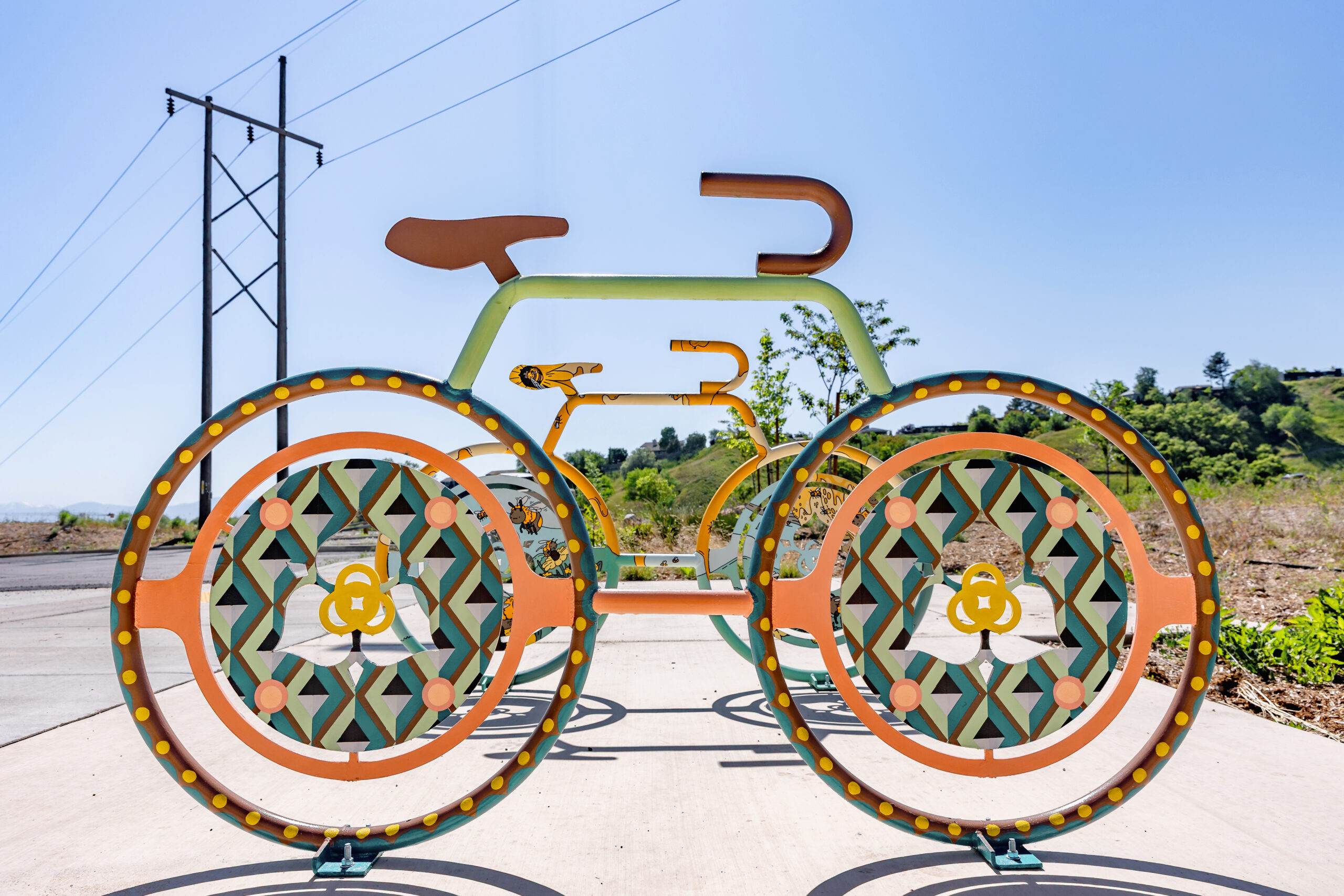
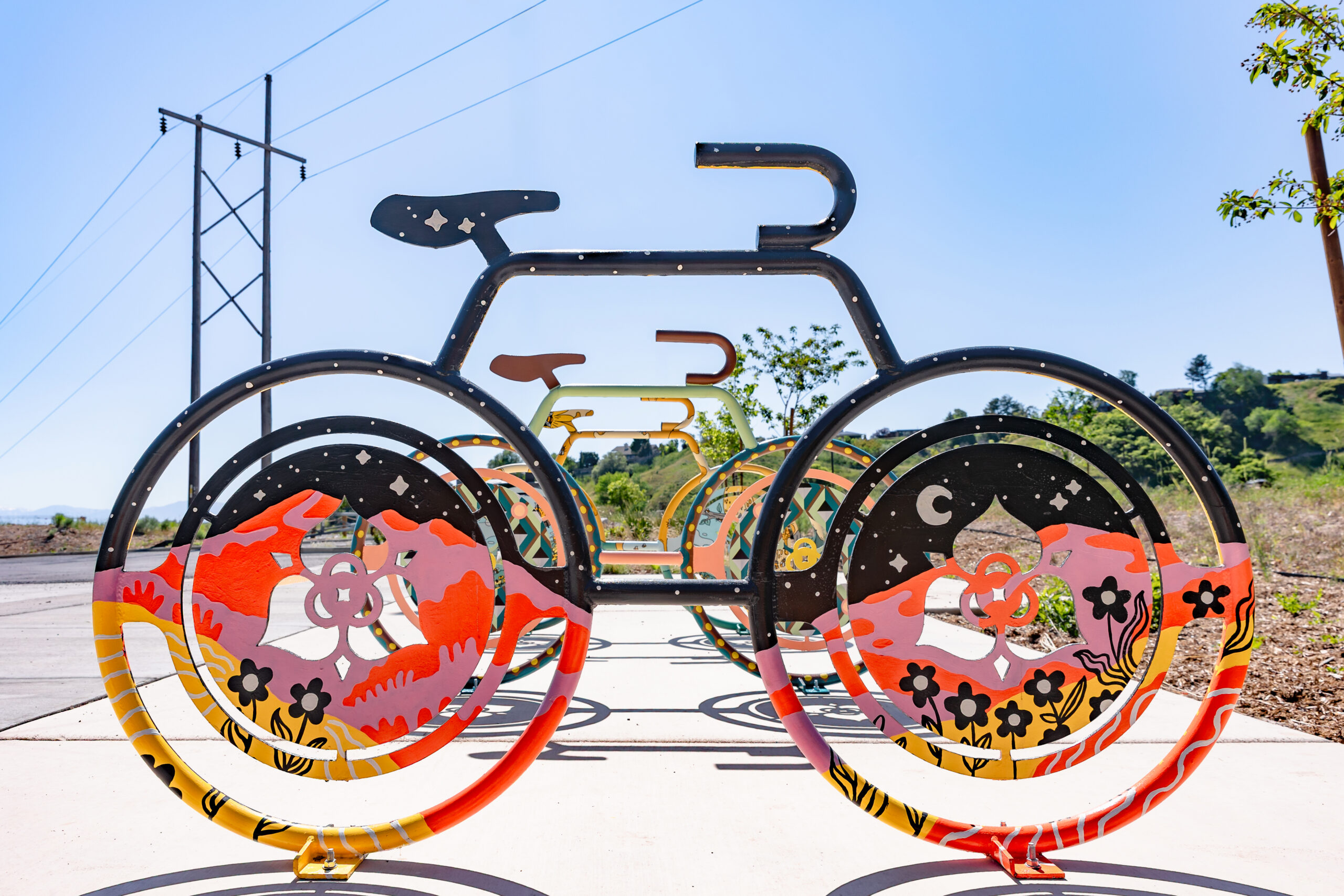
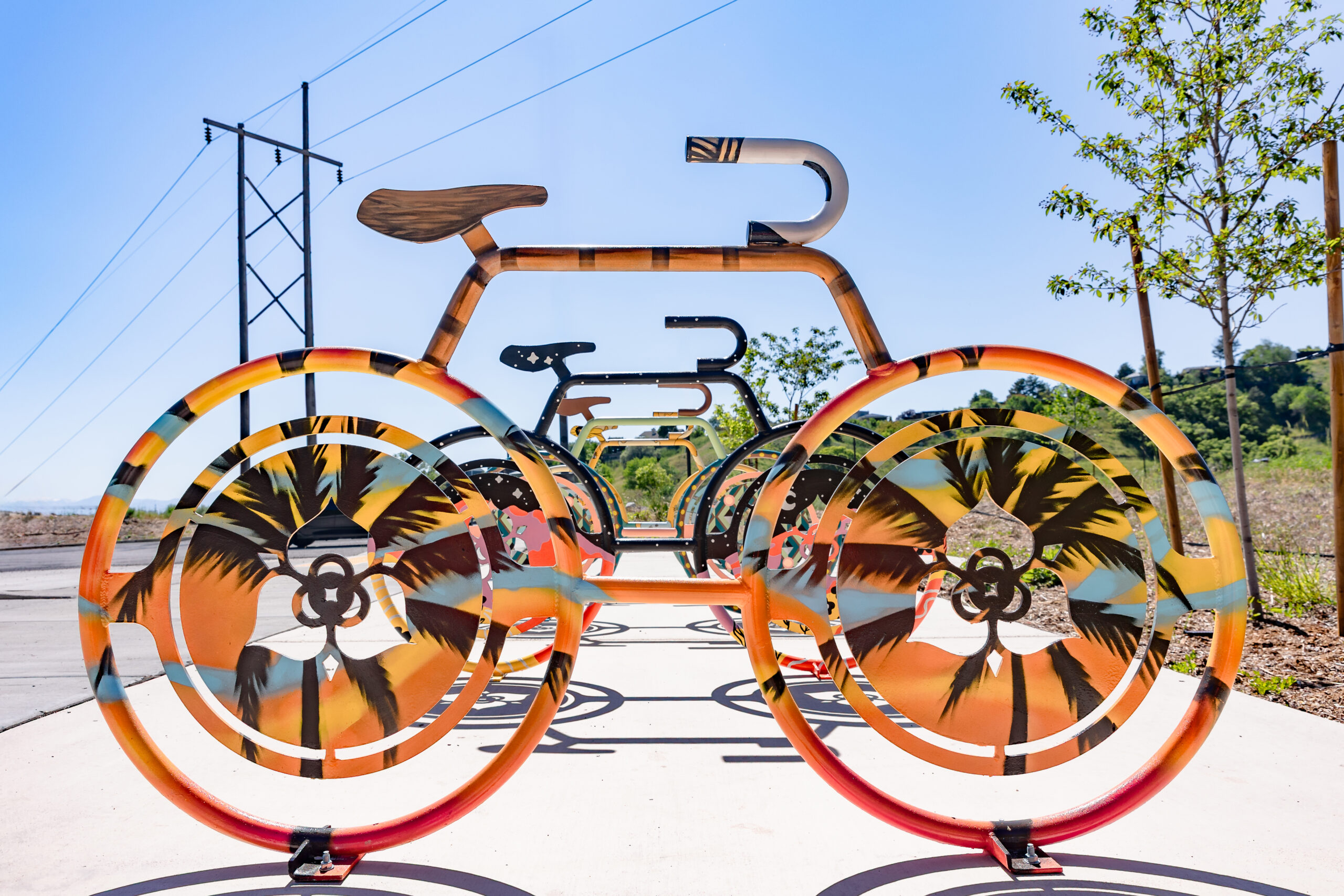
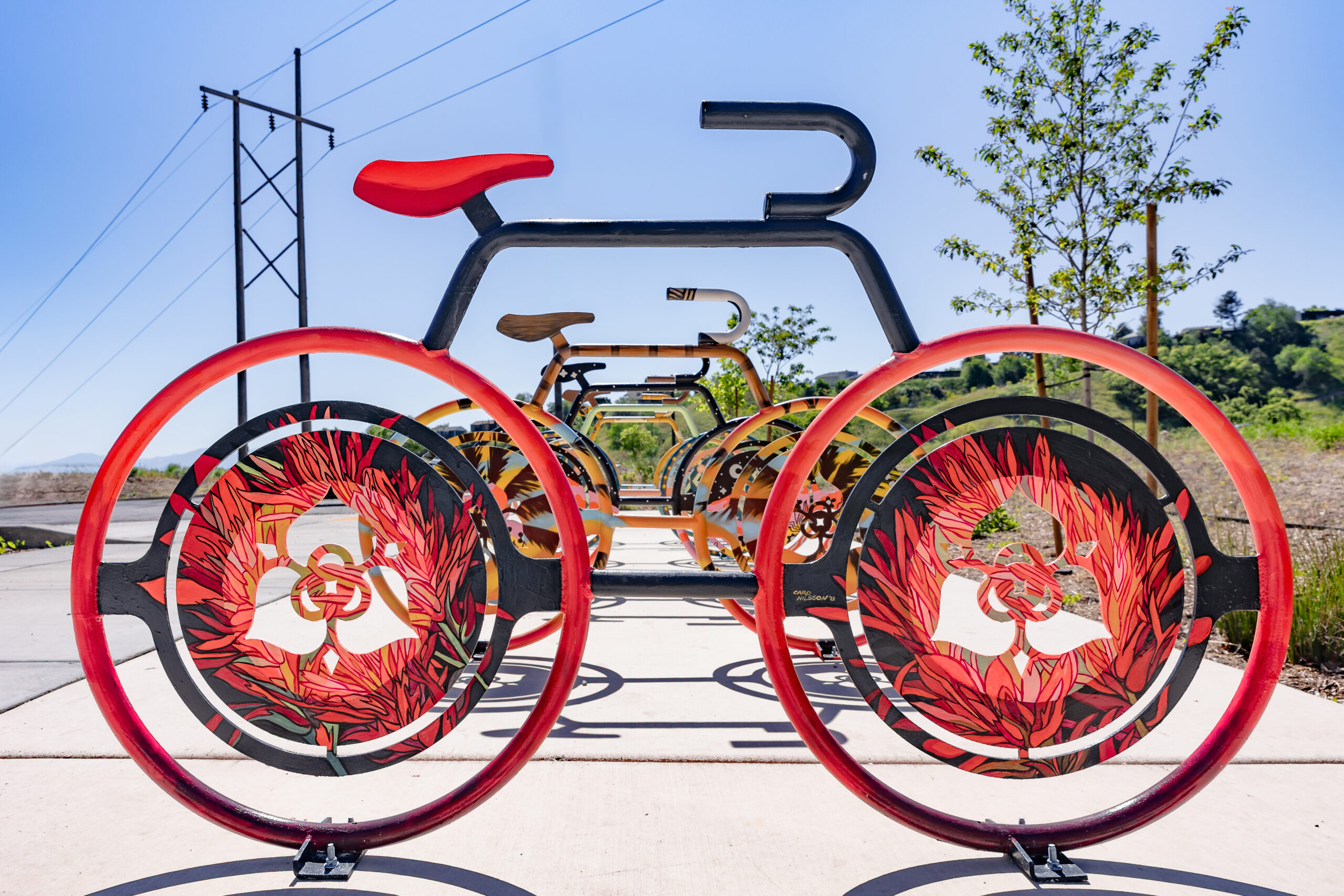
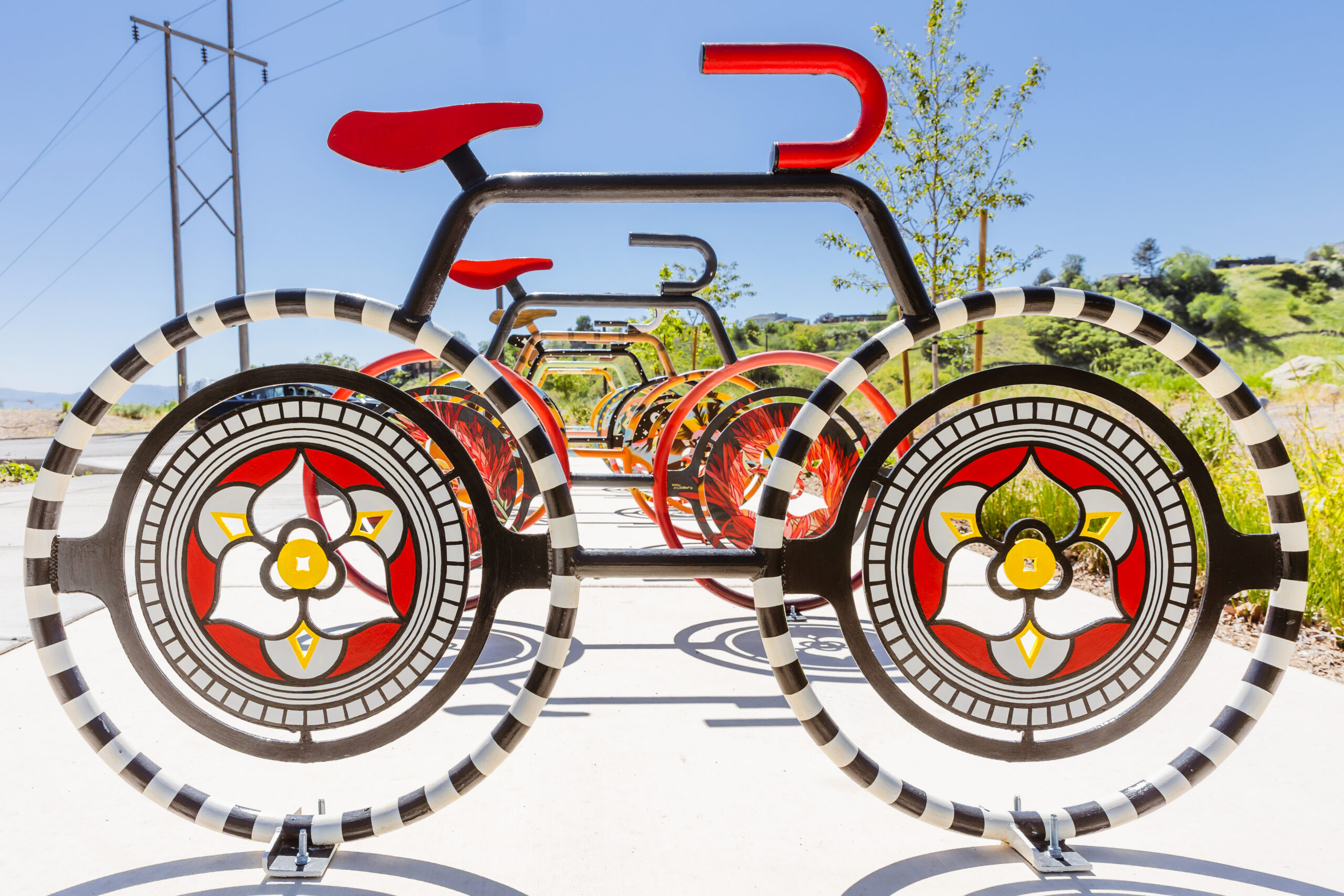
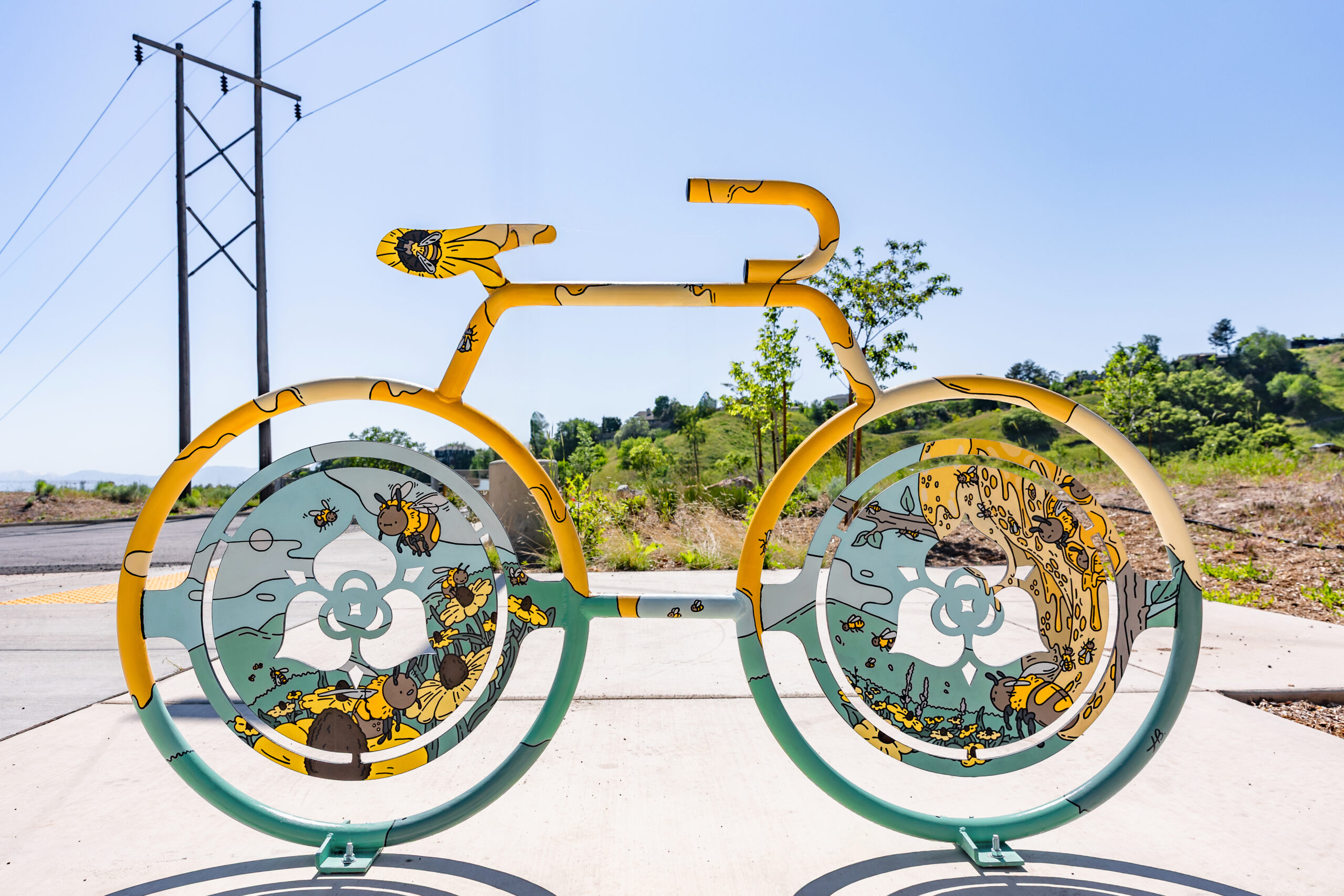
The Foothills Trailheads: Bike Rack Murals public art project features 10 unique bike rack murals painted by local artists, celebrating the ecological importance and rich natural and cultural diversity of Salt Lake City’s Foothills. These murals incorporate imaginative art elements, offering visitors a visually rewarding experience at the trailheads.

This project spans two locations: the Bonneville Boulevard Trailhead and Popper Park Trailhead at 1401 Popperton Park Way. These trailheads serve as major confluences and urban interfaces for the Foothills trails, connecting several Salt Lake City landmarks, including the Avenues neighborhood, the Utah State Capitol, and the University of Utah. We encourage you to explore both trailheads to see all 10 bike rack murals*. Each bike rack features a sego lily cutout in the tires, designed by local artist Derek Ballard.

This project was made possible through the Salt Lake City Arts Council’s Public Art Program, with support from the Salt Lake Art Design Board, Salt Lake City’s Department of Public Lands, community stakeholders, and the artists.

Photo 1.1 – 1.2: Xander Brickey
Photo 2.1 – 2.2: Eric Fairclough
Photo 3.1 – 3.2: Valerie Jar
Photo 4.1 – 4.2: Bill Louis
Photo 5.1- 5.2: Caro Nilsson
Photo 6.1 6.2: Brooklyn Ottens

View the other location of the Foothills Trailheads: Bike Rack Murals at Popperton Park Trailhead.

Photo Credit: Logan Sorenson

___________________________________________________________________________________________________

Xander Brickey


"The mural was inspired by the ecology of the Salt Lake foothills. It depicts friendly honeybees collecting pollen from sunflowers and elephant’s heads—both native Utah flowers."

Eric Fairclough


"My inspiration for my bike rack mural comes from the many years spent exploring the mountains and foothills of Salt Lake City. The muted, earth tone color pallette is meant to reflect the experience of hiking the trails above the city. I wanted something that was bold in the pattern work but that also blended in with the surroundings. Really happy with how it turned out and excited to see it installed and ready for use. "

Valerie Jar

"This design is based on my experiences trail running in the foothills—I wanted to capture the moments where day shifts to night, so one side shows the landscape in bright daylight and the other shows the lower contrast side of the night."

Bill Louis


“The inspiration behind my artwork stems from my culture and the sunset in the Islands with palm trees. From the base that represents bamboo, coconut husk seat and fishing hook for handle bars. All these elements are inspired by Polynesian and Island culture. I wanted to have more Pacific Islander representation here in Utah as their is a growing community here. "

Caro Nilsson


"This bikerack is a celebration of the neighbors we have up in the foothills - the absolute joy of paintbrush exploding in colors that almost vibrate. I want us to remember that the simple act of our noticing, our awe, has the power to make the world around us that much more vibrant."

Brooklyn Ottens


"My mural design was heavily influenced by the presence of the Sego Lily cut into the middle of each wheel. As our state flower, I really wanted the Sego Lily to be the star of the show, so I used simple colors and heavy lines to accentuate the flower to create a vintage, pop art style bike rack."

Bridges Over Barriers

May 13, 2025 by Renato Olmedo-Gonzalez

Bridge Over Barriers is a long-term public art project launched in 2005 by NeighborWorks Salt Lake as part of a neighborhood-building initiative for Salt Lake City’s West Side. Led by Lily Yeh of Barefoot Artists, this project brought together countless local artists and neighborhood residents to create one of Utah’s largest public art projects. Through mosaic and stain concrete murals, the artwork reflects the spirit of the community, inspired by the lives and stories of those who call this neighborhood home. Many residents participated in its creation through workshops held in local churches, schools, community centers, and other spaces.

On the north side, Mother Earth symbolizes the nurturing spirit of Salt Lake City’s natural landscape and resilient communities, representing life and growth. Father Time, on the south side, honors the past while guiding the community forward. Together, they invite reflection on the cycles of life, the passage of time, and our shared role in building a connected and inclusive community. The images in each of the sixteen mosaic-covered columns were determined by the various communities of this area and brought to life by participating artists. The mosaic images depict the diversity, livelihoods, professions, and traditions of the residents of the neighborhood.

The original project, completed in 2012, was made possible by many community members, neighborhood residents, and organizations, including Lily Yeh, NeighborWorks Salt Lake’s Maria Garciaz, Brolly Arts’s Amy MacDonald, Utah Division of Arts & Museums’ Jean Irwin, Mestizo Institute of Culture & Arts’ Ruby Chacón and Terry Hurst, the Utah Department of Transportation, artist Jimmy Lucero, John Riddle, and many others.

In the spring of 2024, Bridges Over Barriers underwent a significant restoration effort. Under the creative direction of Brolly Arts, and in close collaboration with NeighborWorks Salt Lake and the Salt Lake City Arts Council’s Public Art program, a team of local artists dedicated six weeks to restoring and preserving this important community artwork. This restoration effort was made possible by Brolly Arts and the Salt Lake City Arts Council’s Public Art Program, with support from the Salt Lake City Mayor’s Office, NeighborWorks Salt Lake, the Utah Department of Transportation, with assistance from neighborhood residents. The artist team, led by Amy MacDonald, included Fairpark artists Matt Monsoon, Brooklyn Ottens, Jessie Thomas, and mosaic artist Roger Whiting.

Located in both Districts 2 & 3

  • « Previous Page
  • 1
  • 2
  • 3
  • 4
  • …
  • 28
  • Next Page »

Search

For Artists

  • Calls for Artists
  • Artist Selection Process
  • Artist’s Commissioned Work Agreement
  • Gifts or Donations
  • More Opportunities
  • 2020-2022 Pre-Qualified Artist Pool

Resources

  • Salt Lake City Arts Council
  • Salt Lake City Government
  • More Opportunities

Information

  • About
  • Calls for Artists
  • Artist Selection Process
  • Gifts or Donations

Contact

54 Finch Lane
1340 East 100 South
Salt Lake city, UT 84102
Phone: 801.596.5000
Email: publicartprogram@slc.gov

Instagram: slc_publicartprogram

Web Design and Vegas SEO by Firetoss

© Copyright Salt Lake City Arts Council 2014, All Rights Reserved.